
Optimized Pricing built on curves, not coefficients
Every price point carries a cost. Set it too high and volume leaks to competitors and private label. Set it too low and margin stays on the shelf. Accuris gives FMCG commercial teams the econometric evidence to take, defend and optimise every pricing decision: at SKU level, by retailer, recalibrated every quarter.
01
Base Price Elasticity
We map the full elasticity curve across the price range, at category, brand and product level, because the dynamics differ at each. The curve shows where increases pass through cleanly, and the thresholds beyond which volume loss accelerates: private-label parity, the next round number, a competitor's price point.
02
Promotional Price Elasticity
The true incremental return on promotional discounts, TPRs and multibuys. Our models separate genuine uplift from subsidised baseline and identify the optimal discount depth: deep enough to move volume, not so deep that margin is given away for diminishing returns.
03
Cross-Price & Competitive Intelligence
No SKU is priced in isolation. We identify the competitive set for every pack, quantify competitive exposure and determine cross-elasticities. Source of Business™ shows where the volume goes when you raise prices: cannibalisation within your own range, switching to rivals, or shoppers leaving the category.
04
Pricing Simulation Dashboard
An interactive scenario planner for testing pricing and promotional changes before they reach the market. Adjust price points or discount depth, run sequential increases, compare scenarios side by side, and see the impact on volume, revenue, margin and profit instantly.
Built on revealed shopper behaviour, not surveys
Conjoint and other stated-preference methods measure what shoppers say they would do. Our elasticity models are built entirely on what they actually did at the till. The methodology rests on three pillars.
Accurate Baselines
A proprietary Bayesian time-series decomposition separates observed sales into structural baseline, seasonality and events (World Cup, Easter, etc.), promotional uplift and residual noise. Bayesian shrinkage priors keep estimates robust for low-frequency SKUs and avoid the most common pitfall in pricing analytics: mistaking promotional volume for a seasonal peak.
Non-Linear Price Response
Shopper response to price is not linear. A 20% discount generates far more than twice the uplift of a 10% discount, and the second price increase of the year never behaves like the first. We normalise every price movement to a per-1% elasticity and map the full response curve, so you can see exactly where volume erosion accelerates.
Competitor-Aware Modelling
Every elasticity estimate includes competitor price variables. Your elasticity of -1.8 is not measured in a vacuum: it reflects the simultaneous price positioning of rival brands and private label in the same retailer, and it is recalibrated each quarter as that positioning changes.
Quarterly tracking

Quarterly Elasticities
A basic elasticity report, updated every quarter, holding the full coefficient library and elasticity curves for every retailer, at category, brand and product level. It is the analytical backbone from which every strategic output is derived, and it gains precision with each new quarter of data.

Value-at-Risk Report
Knowing your elasticity is necessary but not sufficient. The Value-at-Risk report answers the question a commercial director actually asks: which SKUs are at risk, and where is the opportunity? Every product is classified as over-priced (carrying share risk) or under-priced (carrying margin opportunity), with the commercial impact quantified in currency. A strategic pricing quadrant then maps each SKU by price index and volume share into four zones: power packs to protect, niche premium positions to review, commodity SKUs at risk of delisting, and over-priced products that need immediate action.

Promo Efficiency Quadrant
Every promoted pack is assigned one of four strategic roles, based on its volume lift and its margin return:
-
Efficiency Drivers - High volume lift AND high margin ROI. Protect and optimise.
-
Volume Drivers - High lift, low ROI. Use strategically; cap frequency.
-
Brand Builders - Low lift, high ROI. Deploy for margin enhancement.
-
Subsidisers - Low lift AND low ROI. Redirect spend to higher-performing packs.
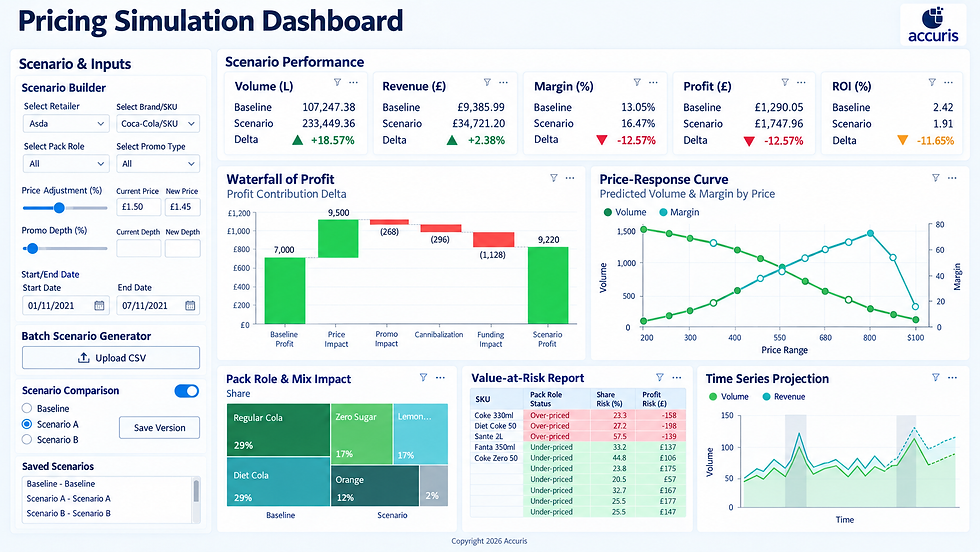
Pricing Simulation Dashboard
An interactive Power BI environment for scenario planning. Build and compare pricing scenarios, test sequential increases, visualise the profit waterfall, identify cannibalisation and project volume, revenue and margin over time. As market conditions change, the simulation updates: a living commercial plan rather than an annual spreadsheet.