
More sales on promotion. But how much more business?

British shoppers spent more than £250 million more on promotions in the four weeks to 4 October 2026 than a year earlier. For promotional teams, that looks like success. The harder question is how much of it was new business, and how much was sales that would have happened anyway, only cheaper.
Five stories from the past week show why that question matters to anyone who signs off a promotional budget.
Listen to the podcast edition (shortened version) or read the full blog below
 |  |
The numbers behind the headline
Worldpanel's latest data shows grocery inflation edging up to 2.5%, while take-home grocery sales grew only 1.0%. Read together, those two figures suggest shoppers are putting around 1.5% less into their baskets than a year ago. Yet in the same four weeks, shopper spending on promotions rose by more than a quarter of a billion pounds.

More of the shop is going through on deal, while the shop itself is getting smaller. A sale on promotion and an additional sale are not the same thing. A promoted sales line can climb steadily while the business underneath it stands still.
Seven places a promoted sale can come from
Every unit sold on promotion comes from exactly one of seven sources. Source of Business, the framework Accuris developed, separates them so each can be measured and managed.

Only one of the seven, category expansion, grows the market. It is also the smallest. Across 44 grocery categories in Great Britain, Accuris finds that of every £100 of promotional spend, only around £11 generates genuinely new demand. Roughly two thirds of promotional uplift is brands trading the same shoppers back and forth.
Now look again at the extra £250 million. In a market where volume is slipping, a large share of it is likely to be subsidised baseline: shoppers who used to pay full price, now waiting for the deal. That is not growth. It is loyal customers learning to pay less.
Whose growth is the promotion buying?
Lidl has invested £400 million in price cuts and promotions in 2026. On 7 October it added a further £75 million in Lidl Plus offers between now and Christmas, including personalised coupons. It is working for Lidl: sales rose 7.1% in the 12 weeks to 4 October, and it gained more than half a million additional shoppers.
For Lidl, a coupon that wins a family's Christmas shop from another supermarket is money well spent. That is retail switching, and for the retailer it is pure gain. For a brand that already sells in both stores, the same move is worth close to nothing. Same product, same household, different till. If the brand helped fund the coupon, it paid for the move.

This is why joint business plans can feel like two parties reading different spreadsheets. The retailer is buying shopping trips. The manufacturer needs category growth. Category expansion is the one source where both sides win, so a joint plan built around it gives both parties the same goal.
How much volume must a price cut buy back?
In February, PepsiCo cut US prices by up to 15% on Lay's, Doritos, Cheetos and Tostitos. Its third-quarter results on 8 October showed North American snack volumes roughly flat, beverage volumes down 2% and core operating margin down 35 basis points, with management pointing to rising input costs. PepsiCo credits its affordability moves with helping volume and share this year, and the results do not isolate the effect of the cuts.
The arithmetic of a price cut is unforgiving, though. Take a product that sells for £1 and earns 40p of gross margin. Cut the price by 15p and it earns 25p. To make the same gross profit, it must sell 60% more.
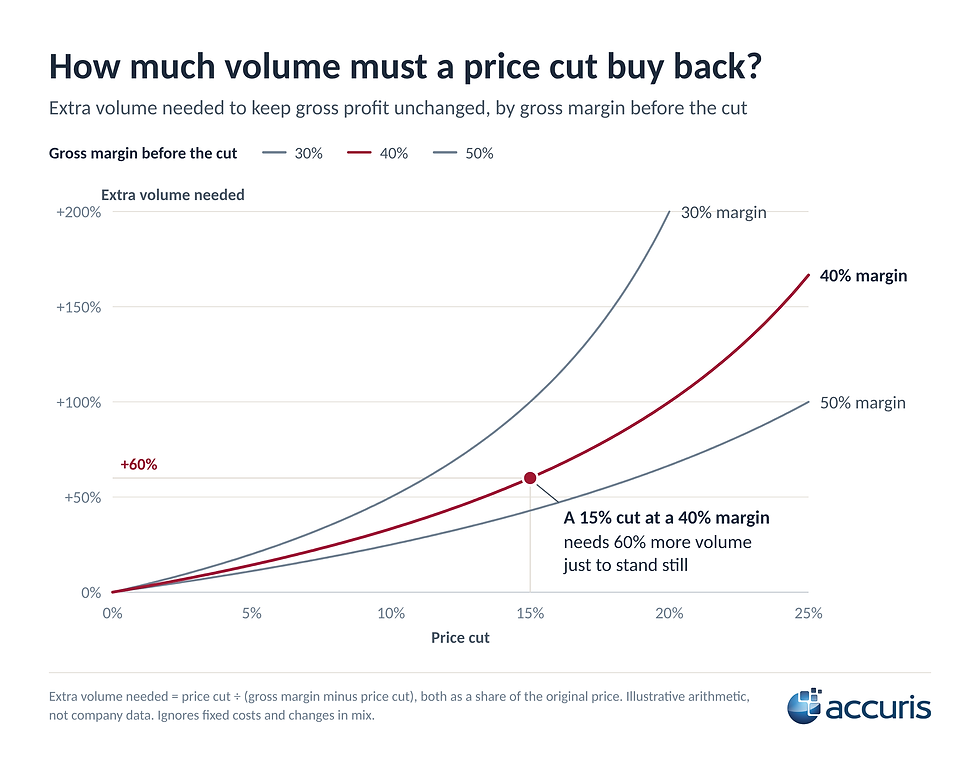
Even when volume comes back, the source matters. If the extra units go to loyal buyers who would have bought anyway, the brand has paid 15% to stand still. If they come from shoppers who had drifted out of the category, that is real recovery. Recovering volume and recovering profit are different objectives, so the better questions are which packs, which shoppers and which retailers deserve the investment.
The squeeze from above
Tesco's interim results showed UK sales of its Finest range up 8.9%, supported by strong volume growth, against 2.4% growth in UK food like-for-like sales. Lidl's chief executive said this month that shoppers want to "trade up and treat themselves at home". Increasingly, that treat looks premium without carrying a brand name.
Most brands set their price gaps against two reference points: the cheapest own label and their nearest branded rival. Premium own label is now a third reference point, and it sits above them. Mainstream brands are squeezed from both sides.
Answering with deeper promotions carries a trap, because the shoppers who respond may be the ones already buying. The better test is whether the brand still earns its premium in the weeks it is not on deal.
One sale, three claims
At its media event on 8 October, Tesco announced influencer video content across its website, app and more than 3,800 in-store screens, alongside a new self-service advertising platform. More ways to reach the shopper also means more ways to count the same sale twice.
Picture one week in which a brand has a Clubcard price, a screen ad near the aisle and an influencer clip in the app. Sales rise. The trade team reports the promotional uplift, the brand team reports its media return and the retailer's platform reports its own attribution. Add the three together and the brand may appear to have sold more than it actually did.
Revenue management and marketing need one view of the incremental profit from everything that ran that week, split by source. Three separate claims on the same uplift keep budgets alive that should be cut.
The question for your next commercial review
More than £250 million of extra promotional spend in a month is clearly more business for some retailers. For most brands, whether it is new business depends on which of the seven sources it came from. The question worth taking into your next commercial review is not how much more you sold on deal, but how much of it you would have sold anyway.
Accuris helps consumer goods companies and retailers measure where their volume comes from, using Source of Business. To see the source profile of your own promotions, get in touch with the Accuris team.
Adapted from the FMCG Weekly podcast episode "More sales on promotion. But how much more business?"
Sources
Connect with an Accuris consultant today to explore how Source of Business Management can help you direct pricing, promotional and commercial investment towards the sources of growth that create the most value.


Comments